
Pressure drop is the real issue
A compressor set to 8 bar does not deliver 8 bar at the tool. Every metre of hose, every coupling and every elbow takes its share, and the effect gets worse as the diameter shrinks. Over 50 m of Ø 6x8 mm hose the drop is already noticeable for a demanding tool; in Ø 8x10 mm it becomes acceptable again.
The rule fits in one sentence: the longer the line, the larger the diameter. The price is drum capacity, which falls by roughly a third when moving from 6x8 to 8x10. A drum rated for 150 m of Ø 6x8 will only hold 100 m of Ø 8x10.
Spring rewind or hand crank
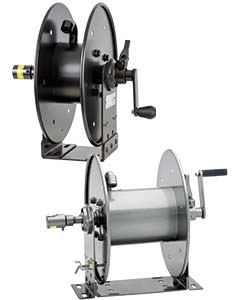
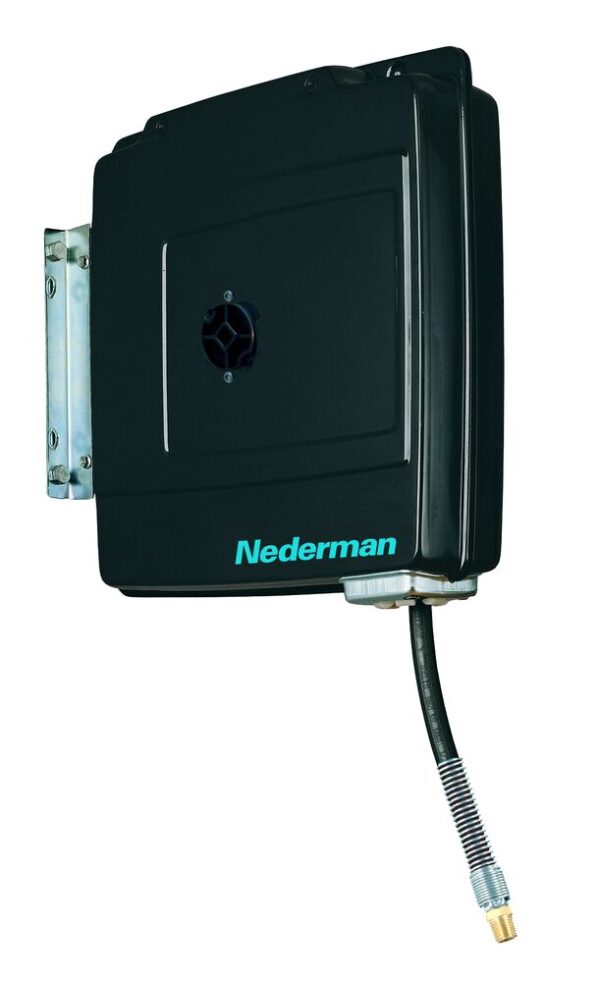
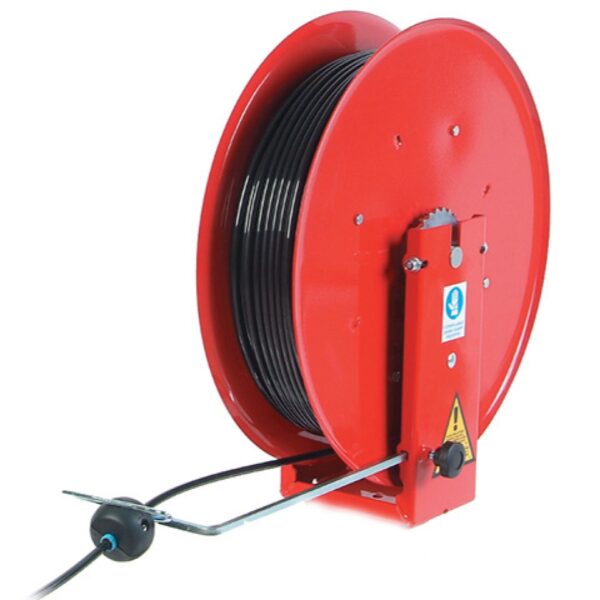
The criterion is frequency, never length. An assembly station where the hose is rewound twenty times a day justifies a spring reel: the hose does not lie on the floor, it is neither crushed nor torn off, and the safety gain is immediate.
A seasonal site where the line is run out in the morning and stowed in the evening does not need it. The manual reel then offers two decisive advantages: a capacity of up to 200 m where the automatic reel tops out at around 100, and a weight of 4 to 6 kg against 20 to 32.
Two distinct markets
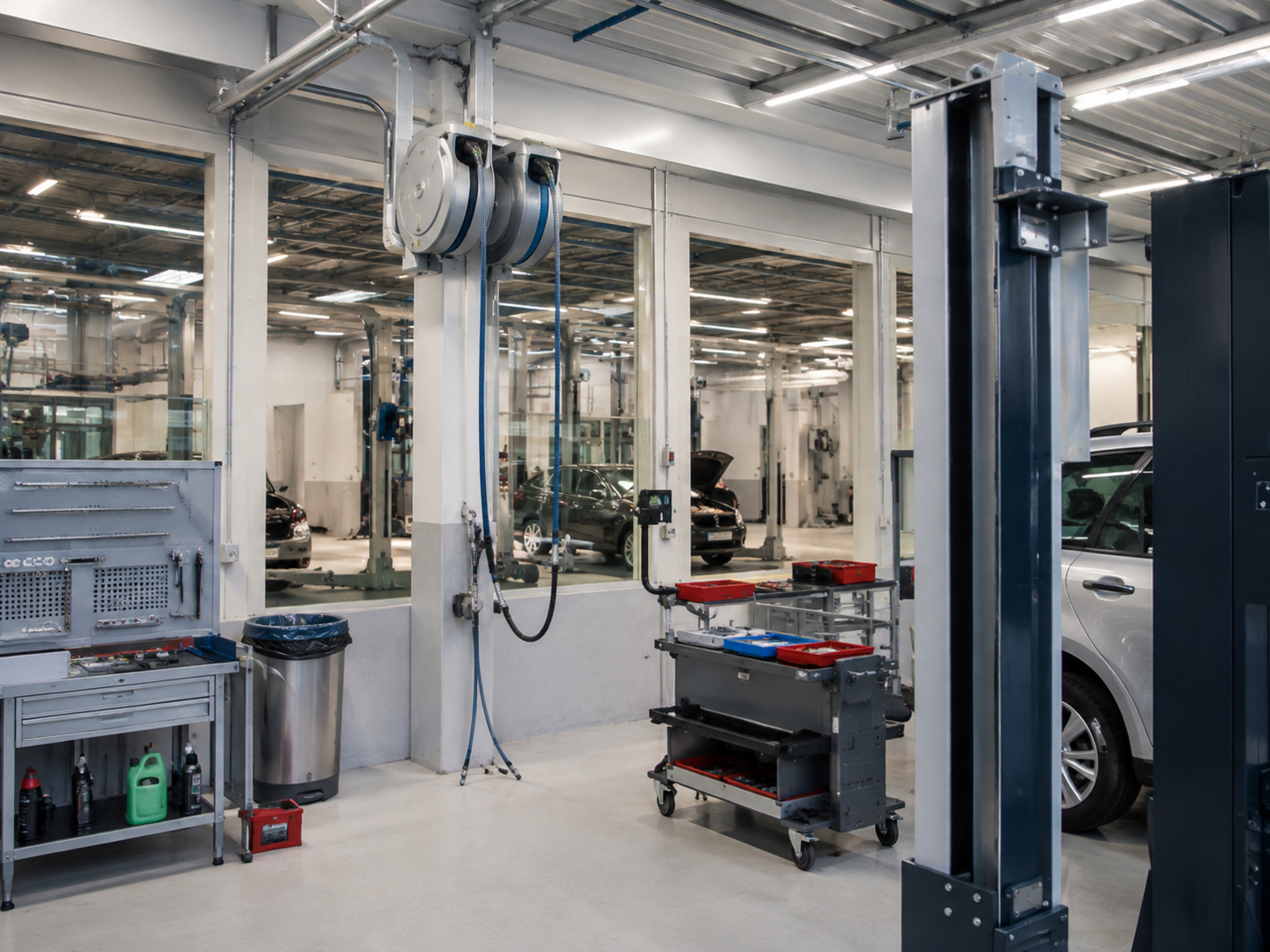
In workshops and garages, the priorities are compactness, automatic rewind and overhead mounting that frees the floor. Lengths stay modest, 10 to 20 m, and 1/4″ couplings are sufficient.
In agriculture, use is seasonal and the distances are of another order. Olive harvesting and pneumatic pruning call for 100 to 200 m of line from a compressor left at a fixed point, with manual rewind and a swivelling bracket.
A third case stands apart from the first two: breathing air, and more broadly air distributed in a wash-down environment. The issue is no longer pressure drop but the cleanliness of the circuit and of the equipment itself. The ELRA from Limatec is built for this case — all 304 stainless steel, smooth surfaces with no traps for dust and dirt, rated to 30 bar, with a 3/8″ BSPL male outlet that belongs to pneumatic lines rather than water lines. It also covers nitrogen and CO2. Fitting a water reel to an air network means adapting the couplings at both ends, and air reveals the slightest leak where water forgives it.
Length and diameter do not add up
A reel drum has a fixed winding volume. The length it accepts therefore falls quickly as the hose cross-section grows, and this is not a range choice but a geometric constraint: it applies to every spring reel, whatever the brand.
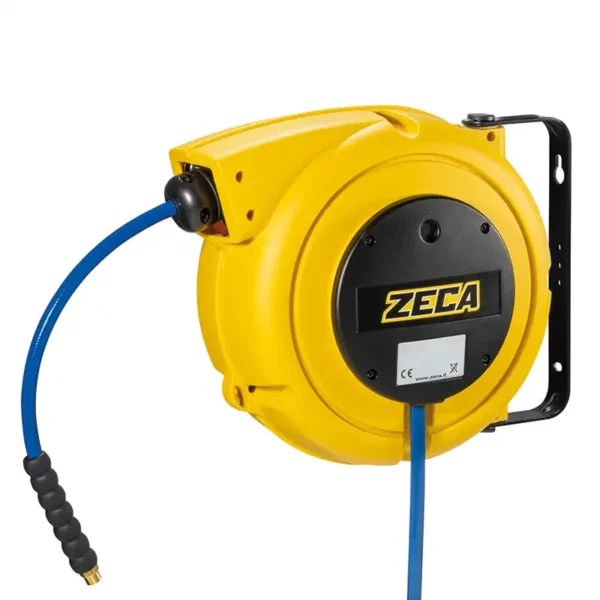
The Zeca 8900 series shows the scale on a single unit: 47 metres of 8 mm hose, 42 metres of 10 mm, 32 metres of 12.5 mm, 17 metres of 19 mm and 10 metres of 25 mm. A requirement that combines great length and large diameter is therefore not met with a spring reel, and it is better to know that before comparing offers than after delivery.
For workshop air, the compromise is most often found around 10 mm: the cross-section is enough for common pneumatic tools and leaves thirty to forty metres of reach. For an isolated station, a compact unit such as the 9100 with its 6.5 metres of 5.5 mm hose covers a blow gun or a tyre inflator without cluttering the bench.