
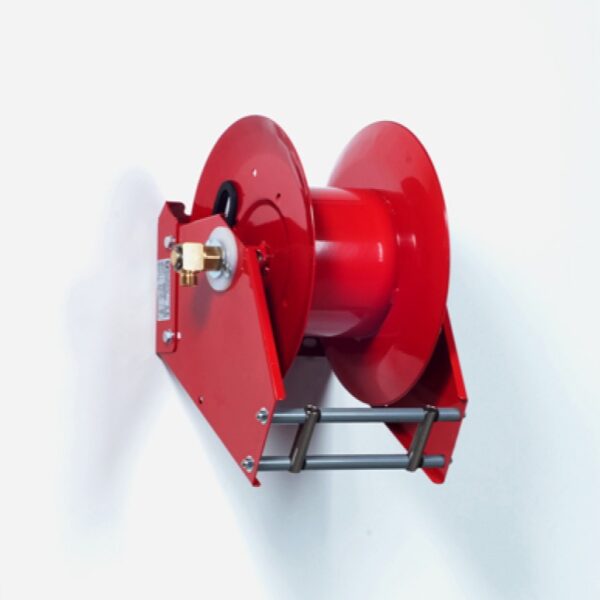
Working pressure, test pressure, burst pressure
Three figures circulate and they do not mean the same thing. The working pressure is the one at which the assembly operates continuously; it is the one shown on our product pages. The test pressure is that of the factory test. The burst pressure is classically four times the working pressure on a high-pressure hose.
The point to remember: the weakest link decides. A reel rated 250 bar fitted with a 160 bar hose is a 160 bar assembly. Always check the consistency between drum, hose and couplings, particularly if the hose is supplied by a third party.
The swivel joint decides service life
It is the part that works hardest and the one that fails first. The body material first: brass for everyday use, zinc-plated steel for high pressure, stainless steel for the food industry and corrosive environments. Then the seals, which dictate chemical compatibility and temperature range — NBR covers the ordinary, Viton and PTFE go markedly higher.
The admissible pressure of a joint falls as its diameter grows: a 3/8″ joint holds well beyond 350 bar where a 2″ joint tops out at around 180 bar. It is a direct trade-off between flow and pressure, with no way around it.
Choosing the length without error
The stated capacity always depends on the drum-and-hose combination, never on the drum alone. The same model commonly holds 70 m in Ø 3/8 but only 50 m in Ø 1/2. Start from the actual distance to cover, add the mounting height and some working margin, then choose the drum able to hold that length in the diameter imposed by your flow rate.