
Diameter comes before pressure
Flow varies with the square of the inside diameter. Moving from Ø 1/2″ to Ø 3/4″ costs almost nothing at purchase and practically doubles the flow available at the end of the line. Conversely, raising the supply pressure to compensate for a hose that is too thin wears the pump without solving the problem.
The trade-off is capacity: the same drum commonly holds 100 m in Ø 5/8 but only 70 m in Ø 3/4. Sizing is therefore done in two steps — the diameter first, imposed by the required flow, then the drum size, imposed by the length.
The material is chosen for the environment, not the fluid
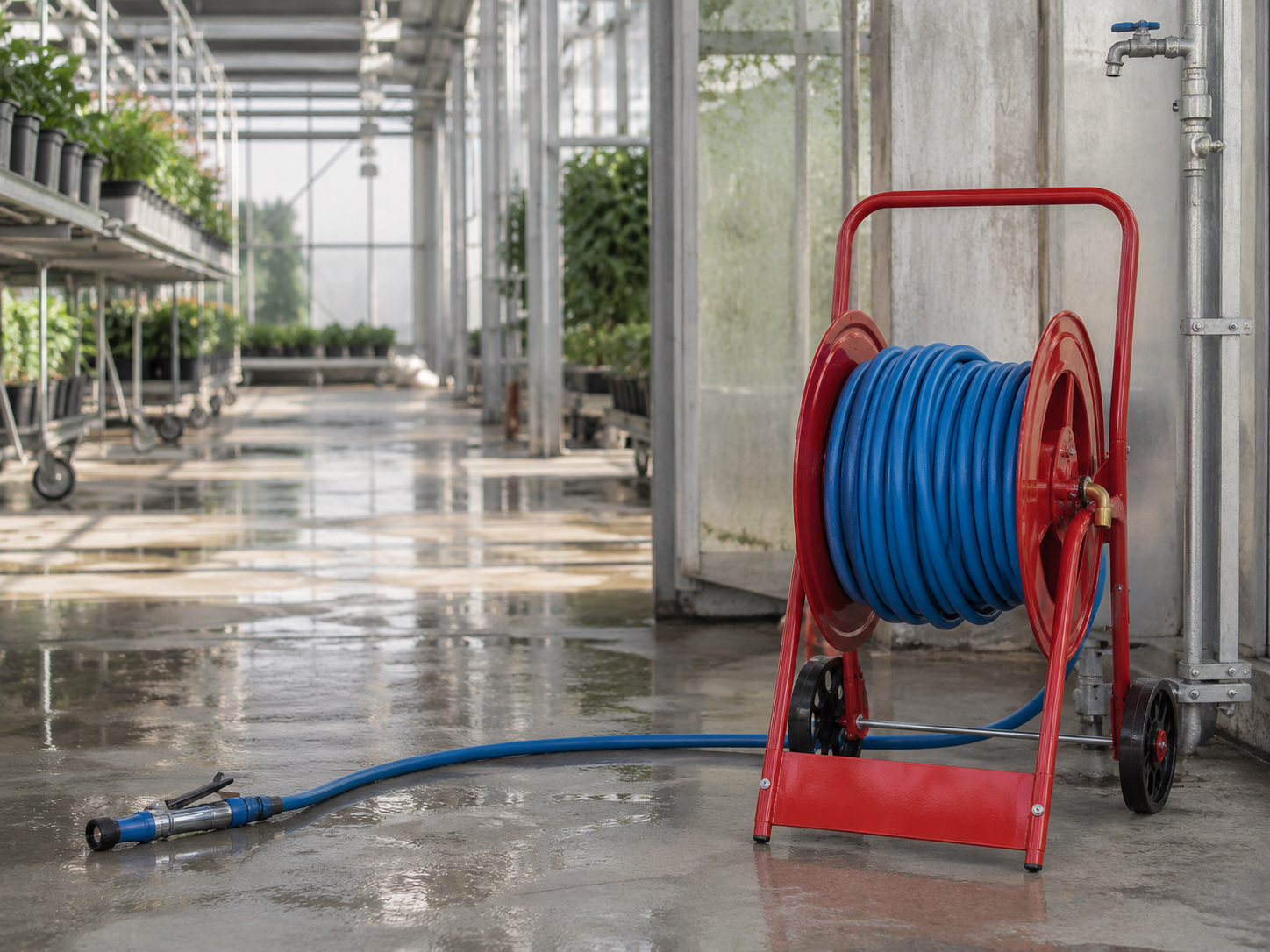
Polyester powder-coated steel is the standard in workshops and under cover: UV-resistant, economical, sufficient as long as the reel is not permanently exposed to moisture. Galvanised steel takes over for permanent outdoor use, in greenhouses, on the coast and on washing bays, with identical dimensions and capacity.
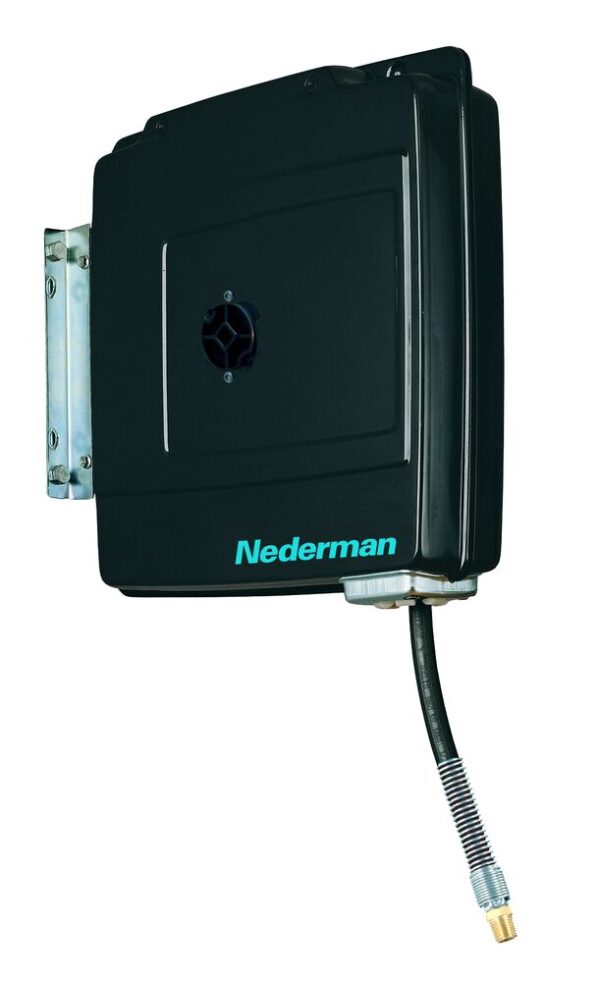
304 stainless steel is required in the food industry and wherever regular chemical cleaning takes place, 316 in the presence of chlorides or sea spray. Technopolymer, finally, offers a corrosion-proof enclosed casing for small fixed stations.
Fixed, spring-rewind or on a trolley
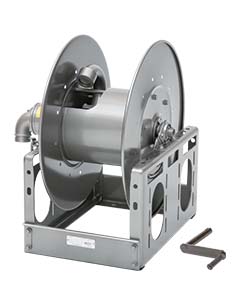
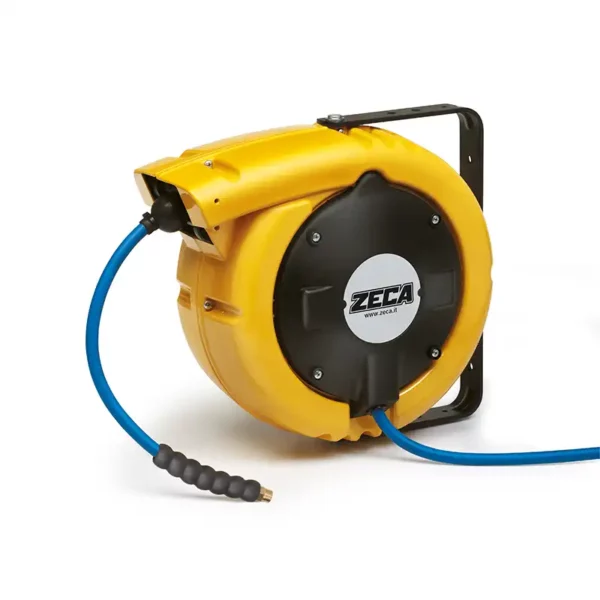
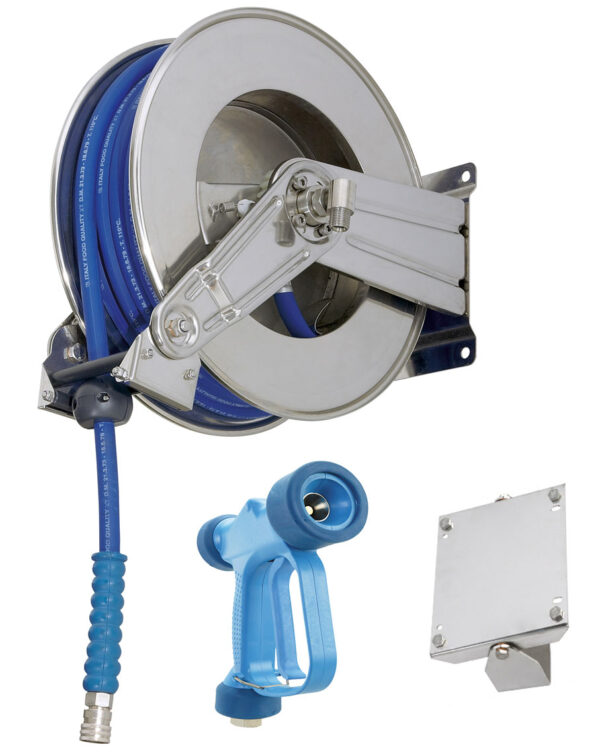
The fixed wall bracket suits the permanent water point, where rewinding by hand crank remains occasional. The automatic spring rewind is needed when the hose comes back several times a day: it keeps the hose off the floor, but it is limited in length and weighs considerably more. The trolley answers the opposite need, when the reel has to follow the work.
On trolleys, the type of wheel is not a detail: solid wheels suit hard surfaces, pneumatic wheels cross loose soil and tall grass where a loaded rigid wheel sinks in.
A fourth solution exists, often dismissed out of reflex although it answers some stations better than the other three: the storage bracket, with no mechanism. The Limatec Support Cambré takes up to 87 m of 13 x 22 mm hose — where a manual reel from the same brand holds 40 m in that size and a spring model only 20. No spring, no ratchet, no swivel joint: nothing that can break down, and a cost that allows every water point to be equipped instead of just one. The trade-off is real, as rewinding is done entirely by hand, in coils. The rule that emerges: the bracket for long lengths in occasional use, the reel for the station whose hose comes back several times a day.
Large diameter is not paid for in length alone
Moving to a 19 or 25 mm hose to gain flow costs windable length, which is expected. Less expected is that the admissible pressure falls at the same time, because the hose changes nature: the large diameters of a spring reel are in flexible PVC where the small ones are in polyurethane.
The Zeca 8900 series shows it within a single range: up to 12.5 mm the KPU hose holds 20 bar and withstands +50 °C; in 19 and 25 mm the black PVC tops out at 10 bar and +40 °C. The criterion to check against any offer is therefore twofold — what length, but also what pressure and what temperature at that particular diameter, not those stated at the top of the range.
For cold washing water under 10 bar, these versions are perfectly suitable. It is beyond that, or on hot water, that a different family is needed.