
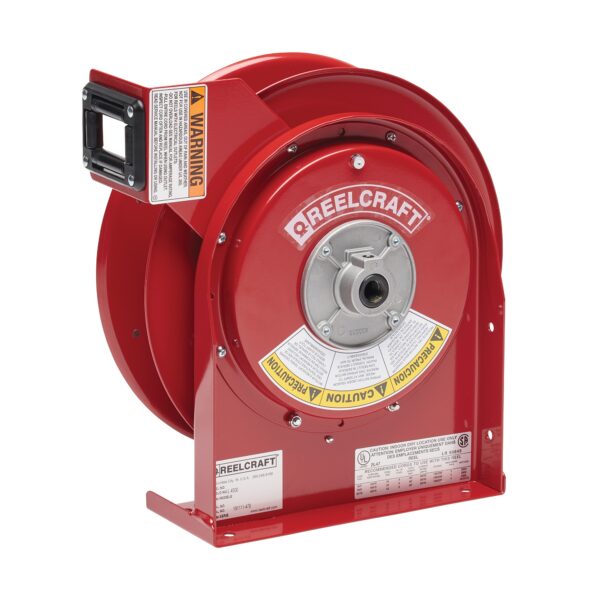
Gas welding: two hoses that must never meet
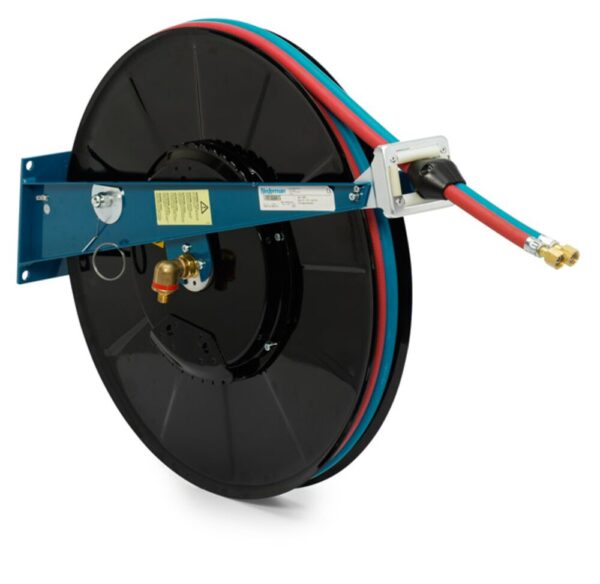
An oxy-acetylene station carries pure oxygen and a fuel gas side by side. Kept apart, they are manageable; mixed, they form a detonating atmosphere. The whole point of a welding reel is therefore to guarantee that the two circuits never communicate, including after years of wear.
On an ordinary twin reel, the two hoses share the same swivel-joint body. A worn seal can then bring the gases into contact — and the mixture forms inside the drum, upstream of any flashback arrestor, hence where nothing can stop it.
Welding reels worthy of the name fit two independent joint bodies. The separation is structural: even a failed seal cannot create communication between the circuits. That is what justifies the price difference with a generic twin reel, and it is the first point to check.
The oxygen rule, which allows no exception
No trace of oil or grease may come into contact with pressurised oxygen. Concentrated oxygen lowers the ignition temperature of fatty substances to the point that they ignite spontaneously, without spark or flame.
Three practical consequences, found in every workshop procedure.
A reel that has carried oil or grease is never converted to oxygen, whatever the flushing. Oxygen couplings are not lubricated, neither at assembly nor at maintenance. And hands, gloves and rags in contact with the couplings must be free of grease.
That is also why welding reels are delivered new and degreased, and why a second-hand drum is never reused for this purpose.
The hose grade depends on the fuel gas
Not all welding hoses are equal, and the difference cannot be seen.
A hose qualified for oxygen-acetylene suits the most common pairing in workshops. A hose qualified for all fuel gases, designated T-Grade by several manufacturers, is required as soon as the station uses propane, propylene, MAPP or a mixture: the components of these gases attack the rubber of standard hoses.
The degradation is internal and progressive. It gives no visible sign before the leak. If your station may change gas, or if you are not sure what will be connected to it in five years, the all-gas hose is the prudent choice.
Identification and couplings: two safeguards
Welding hoses are colour-coded — conventionally blue for oxygen and red for acetylene in France, with practices that vary by country and manufacturer. Check the coding in force at your site rather than relying on habit.
The second safeguard is mechanical: fuel-gas couplings have a left-hand thread, oxygen couplings a right-hand thread. Swapping them at assembly is therefore physically impossible. The standard coupling for welding gases is 9/16-18.
Flashback arrestors belong to the installation and not to the reel, but their presence conditions the safety of the whole. They are fitted at the regulator and at the torch.
Arc welding: the electrode cable
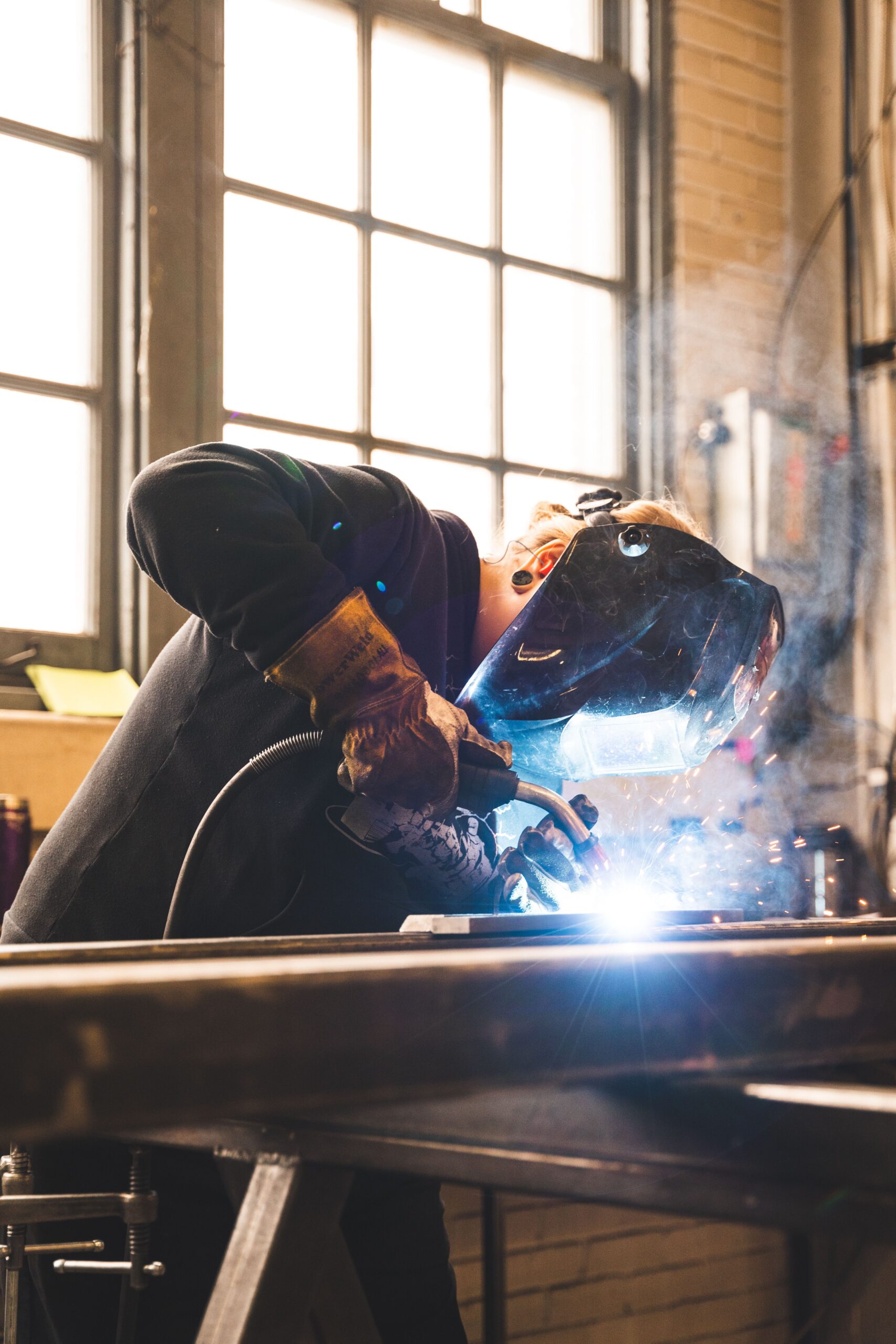
The need is quite different. There is no longer any gas but a single large-section cable, typically 75 mm², carrying a current that can reach 400 A at low voltage.
An extension-lead reel is not sized for this: its slip ring, rated for 10 to 30 A, would heat up and degrade within a few operations. A welding cable reel is needed, whose slip ring and cross-section are designed for the current.
Added to this is the derating specific to any wound cable: a conductor left on its drum dissipates its heat poorly, and its admissible current is lower than its unwound value. On an arc welding station, where current flows in short but intense cycles, it is a point to check. The subject is detailed on our page dedicated to electrical cable reels.
Single or dual support
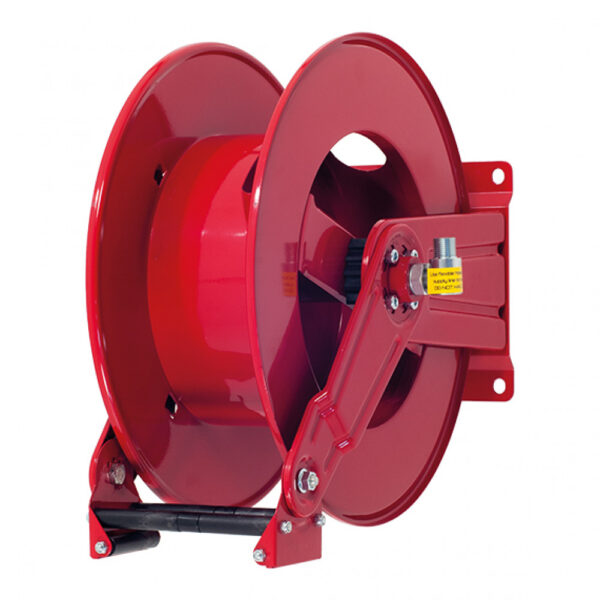
On a fixed workshop station, a single-leg reel is fine. On a vehicle-mounted installation, a site or a workshop where the reel works permanently, the dual-support base spreads the loads over two anchor points and eliminates the most common failure mode, fatigue of the sheet metal at the fixings.
Dual-support versions remain limited in length, however, at around 21 m, where large single-support drums reach 76 m.