
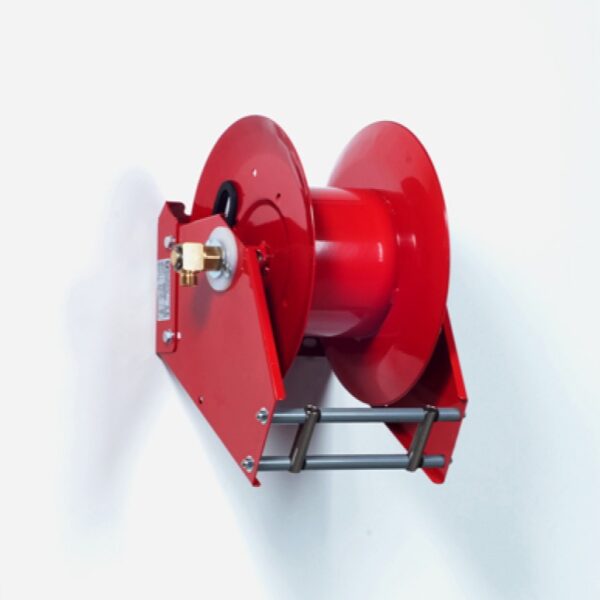
The stainless steel of the frame and the quality of the hose are two separate subjects
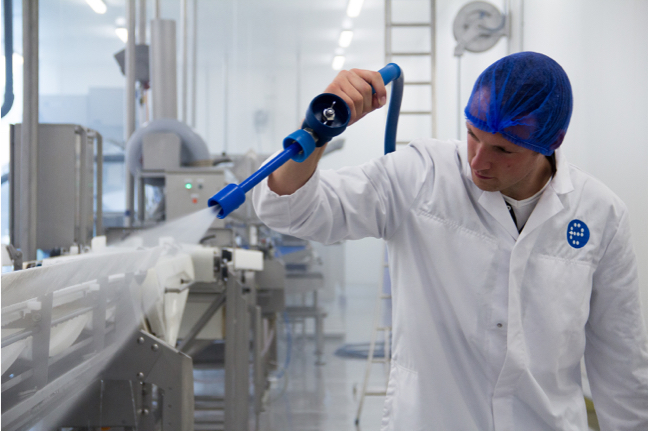
It is the most frequent mistake in this market, and it comes from an understandable shortcut: a stainless steel reel is ordered in the belief that the food-industry requirement has been met. The stainless steel of the frame answers two real needs, resistance to corrosion by cleaning products and the cleanability of the unit itself. But it says nothing about the hose, and it is the hose that carries the water sprayed onto surfaces in contact with foodstuffs.
A food-grade hose is recognised by its FDA compliance and its composition, designed to yield nothing to the fluid. An ordinary industrial hose fitted to a stainless steel frame gives an assembly that appears compliant and is not. That is precisely what the reel supplied fitted avoids: the consistency of the chain is guaranteed at order, not at installation.
The admissible temperature is almost never that of the reel
Food-industry wash-down uses hot water, and the question of the maximum temperature comes up every time. The answer cannot be read on the reel’s data sheet.
On a complete assembly, the food-grade hose commonly holds 120 °C, the washing device 90 °C, and the stainless steel frame far more. The assembly therefore works at 90 °C: the weakest link governs, and it is not the one you look at first. The same reasoning applies to pressure, often limited to 10 bar by the hose while the swivel joint would accept twenty times more.
The practical consequence is that you do not raise the limit of an assembly by improving only one of its components. You have to identify which one constrains it, then check what the chain becomes once it is replaced.
A worked example makes it concrete. On Limatec reels, the body of the unit is rated 170 °C excluding hoses and accessories. The Bergalav EPDM hose fitted to it accepts 160 °C. But the blue brass washing gun supplied by default tops out at 55 °C: the assembly therefore works at 55 °C, three times less than the reel’s data sheet announces. Replacing that gun with the red 316 stainless steel model brings the chain to 95 °C. It is a change of accessory, not a change of reel.
AISI 304 or AISI 316: chloride decides, not the budget
Both grades are austenitic stainless steels and look alike. The difference lies in the addition of molybdenum in 316, which gives it superior resistance to pitting corrosion.
AISI 304 suits the majority of workshops washed with hot water and common alkaline detergents. AISI 316 becomes necessary as soon as chlorides come into play: chlorinated disinfectants, brine in curing plants, seafood, saline atmosphere on the coast. At those stations, a 304 pits within a few months in places the wash-down does not reach.
Our whole stainless steel range exists in both grades; 316 is ordered as an option, with no change in dimensions or capacity.
One exception deserves to be known: Limatec reels are built exclusively in AISI 304, with no 316 variant. In return, the construction pushes cleanability further than the grade alone allows: total absence of cavities and dead spaces, fully dismountable surfaces, swivel joint machined from solid. In a workshop washed with hot water and alkaline detergents, it is the best of both parameters; in the presence of chlorides or brine, a range available in 316 is needed.
ATEX in the food industry is a matter of dust
The reflex associates ATEX with gases and solvents. In the food industry, the risk comes from combustible dusts: flour, sugar, starch, milk powder, proteins. In suspension and at sufficient concentration, they form an explosive atmosphere that places premises in zone 21 or 22, depending on whether the presence is occasional or permanent.
Our stainless steel spring-rewind reels can be supplied with certification under Directive 2014/34/EU, group II category 2. The installation zone must be specified at enquiry, because it determines the configuration chosen. The subject is developed on our page dedicated to ATEX reels.
Bare or fitted: what each choice commits
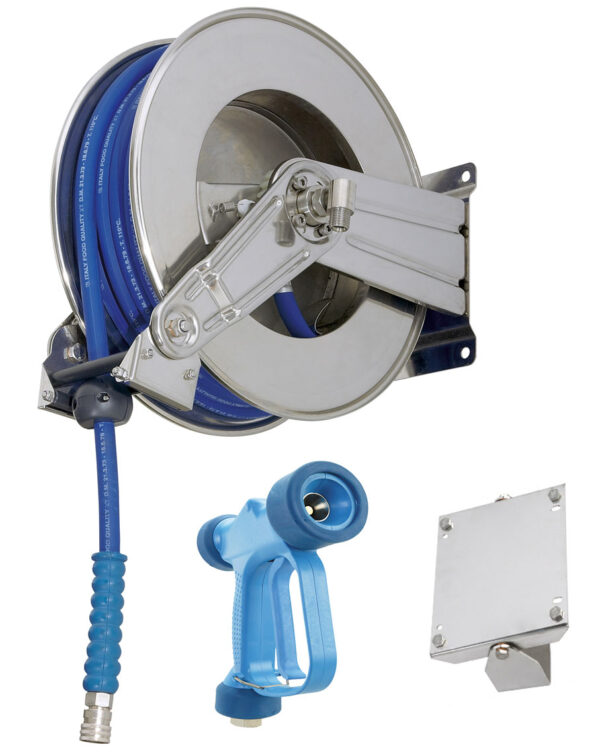
The reel supplied fitted arrives with its food-grade hose, its washing device and its connection lead. It avoids the chain inconsistency described above, and it also avoids a frequent oversight: the connection on the supply side must be flexible. A reel connected with rigid pipe transmits every jolt of the spring rewind to the network, which fatigues the connection until it leaks.
The bare reel keeps its point when the hose is already standardised at the customer’s, when the process requires a particular composition, or when the unit complements an existing installation. Our whole range can be ordered in both configurations.
The link you do not see: the waterway
The weakest-link reasoning set out above has a blind spot. You check the frame, the hose, the washing device — everything visible. The internal circuit through which the product passes, however, is not visible, and it is not always made of the same material as the body.
Some manufacturers embrace the distinction to the point of making it their range classification. At SEKO, reels are not sorted by body material but by waterway: brass on the line intended for kitchens, stainless steel on the line intended for industry. Brass suits water and common alkaline detergents, and copes less well with chlorinated products and descaling acids.
A stainless steel exterior with a brass waterway remains a kitchen model, and the photo will not tell you. The swivel joint being the wearing part of an automatic reel — the one that leaks first — it is this choice that decides service life. And unlike the temperature limit, it cannot be recovered by changing an accessory.
The question to ask of any offer fits on one line: what material are the swivel joint and the internal circuit made of. It does not call for the same answer as “is the reel in stainless steel”.
Frequently asked questions
Does a stainless steel reel necessarily have a stainless steel waterway?
No, and it is a frequent confusion. The internal circuit and the swivel joint through which the product passes may be brass on a unit whose body is stainless steel. Brass suits water and common alkaline detergents but copes less well with chlorinated products and descaling acids. The question to ask concerns the material of the swivel joint and the internal circuit, not that of the frame.
Is a stainless steel reel enough for the food industry?
No. The stainless steel of the frame answers cleanability and corrosion by the environment, but it says nothing about the hose. It is the hose that touches the product, and it alone must be food-grade.
AISI 304 or AISI 316: which to choose?
The criterion is the presence of chlorides. 304 suits the majority of workshops; 316 is required with chlorinated disinfectants, brine or a saline atmosphere, which pit 304.
What temperature does a wash-down reel accept?
That of its weakest component. On a complete assembly, the hose commonly holds 120 °C and the washing device 90 °C: it is 90 °C that applies, whereas the frame would accept more.
Does ATEX concern the food industry?
Yes, through dusts and not gases. Flour, sugar and milk powder place premises in zone 21 or 22. Our stainless steel spring reels can be certified under Directive 2014/34/EU, group II category 2.
Should you order a bare or a fitted reel?
The fitted assembly avoids fitting a non-food-grade hose to a stainless steel frame. The bare reel is justified when the hose is already standardised at the customer’s or imposed by the process.
Why a stainless steel frame rather than a painted steel frame?
For corrosion, obviously, but there is a second reason rarely stated that weighs more in the food industry: the absence of paint. Paint flakes, and a paint chip found in a product is a quality incident, with all that implies in traceability and possibly batch destruction. A stainless steel reel has nothing to flake. It is the argument Hannay puts forward for its stainless steel series intended for dairies, bottling and food processing, and it applies to every brand: above a production line, the bare frame is preferable to the coated frame, whatever the quality of the coating.
Is a reel suitable for drinking water?
Only if it has been prepared for it, and that preparation is requested at order. It covers two points: the hub, which is cleaned, and the swivel joint, whose lubricant must be food-grade — an ordinary technical lubricant is in contact with the fluid and has no place on a network of water intended for consumption. Hannay offers this preparation as an option across its stainless steel range, specifying that it must be requested: it is not applied by default and cannot be recovered after delivery. The same logic applies to fuel dispensing, which calls for a different choice of seals.
A washing station to equip?
Tell us the length needed, the temperature and pressure of your network, the cleaning products used and the possible presence of combustible dusts. We determine the stainless steel grade, the hose diameter and the bare or fitted configuration that suit your workshop.