
Why the pressures are so high
An NLGI 2 grease does not flow under its own weight. It has to be forced, and the force rises with length and falls with diameter. Grease pumps therefore work at ratios of 50:1 or 65:1: fed with 8 bar of air, they deliver 400 to 520 bar at the outlet.
That is the most common mistake with this fluid: sizing the reel on the air-line pressure instead of the pump’s delivery pressure.
Short and narrow, contrary to intuition
One might think a large diameter eases the passage. With grease the opposite applies: the hose stays small because it has to hold 400 bar, and a large-diameter high-pressure hose becomes stiff to the point of being unusable.
Length follows the same logic. Greasing stations are organised as multiple points rather than long distances.
Which part actually carries the pressure rating?
A reel rated 400 bar is never entirely so. The drum, the swivel joint, the hose and the couplings each have their own limit, and the lowest one governs the assembly. The question to ask in front of any offer is therefore: is that value the rating of the body of the unit, or of the swivel joint that lets the grease through?
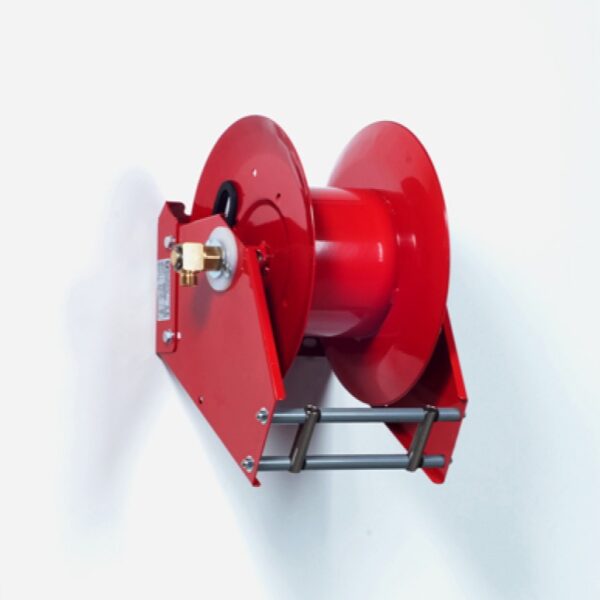
The Zeca 8400 series illustrates the answer better than any speech. It offers three reels supplied bare, without hose, on the same drum: the 8401 is rated 20 bar, the 8440 180 bar and the 8460 400 bar. They are not three times the same empty unit; they are three different swivel joints. Fitting a high-pressure hose yourself on an 8401 will never bring it to 180 bar.
For greasing, the references that genuinely hold 400 bar are the 8462 and 8463, with 6 mm hose in 12 and 18 metres — short and narrow, exactly what the physics above dictates.