

A need born of use, not of the charger
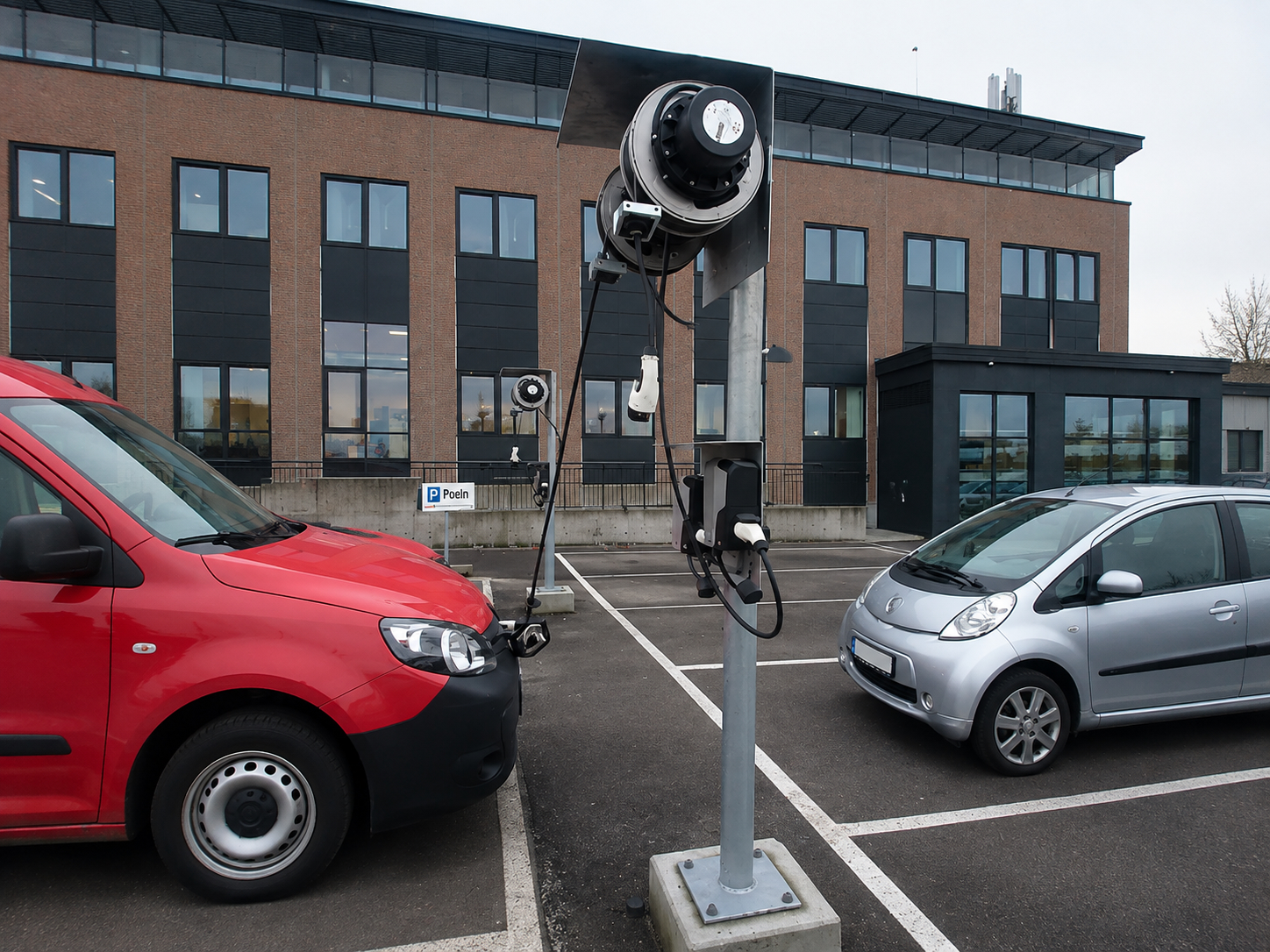
A charging station is sized to deliver energy, not to stow its cable. On an isolated bay, the charger’s holder is enough. In a fleet car park, a workshop or a bus depot, where several vehicles follow one another every day, the reel solves wear, clutter and the trip hazard in one go — and considerably extends the life of a cable whose replacement is not trivial.
Derating applies here too
Like any wound cable, a charging cable dissipates its heat poorly on the drum. On a charge of several hours at rated current, it is a genuine point of vigilance: sizing must take account of the admissible value when wound, not the one measured with the cable deployed.
The ingress protection rating before the power
The first sort on a charging reel is not power but exposure. A unit rated IP42 withstands dripping water up to fifteen degrees of tilt; it is intended for an enclosed garage. A unit rated IP65 is dust-tight and resists water jets from any direction: it alone can be fitted on a façade, under a canopy or in an open car park.
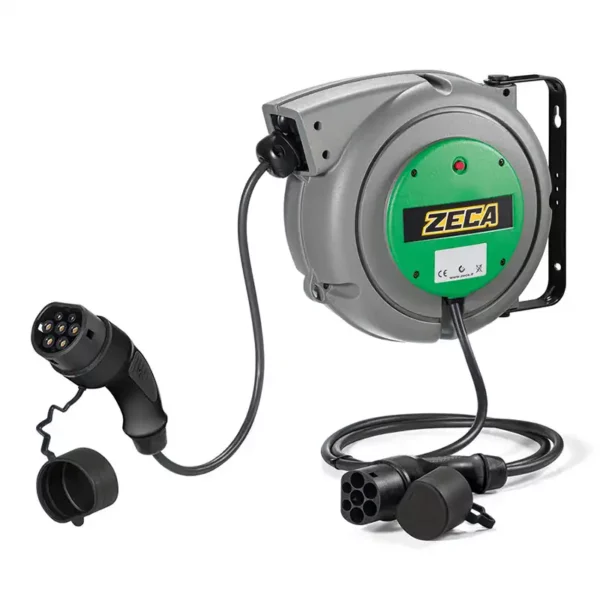
The difference cannot be seen on a photo, and an indoor unit installed outdoors works perfectly until the day it rains sideways. At Zeca, the EV3 and EV4 series are IP42, the EV6 series IP65: it is the only possible choice outdoors, and it rules out three quarters of the range before kilowatts are even discussed.
Charging power is calculated by subtraction
A charging reel transports power, it does not produce it: the value reached is what the charger delivers, within the limit of the cable cross-section. And the charger itself is bounded by the meter.
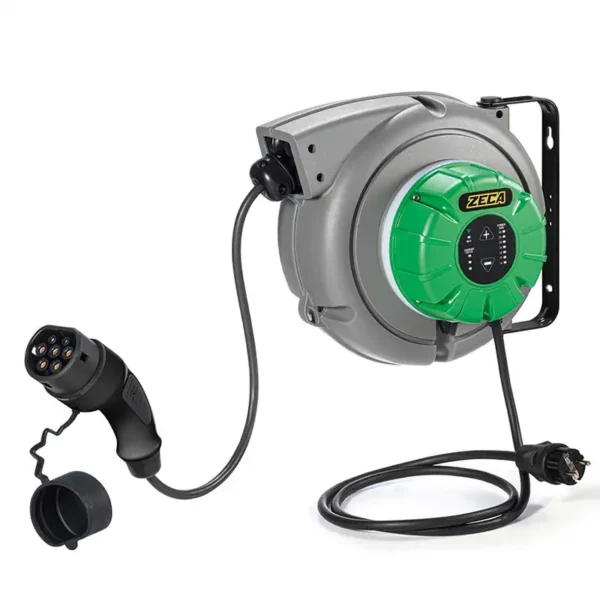
The sizing rule fits in one subtraction: available charging power equals meter power minus the consumption of the rest of the premises at the same time. On a 3.7 kW supply where household appliances already take 2 kW, charging must be set to 1.7 kW at most. That is why an adjustable charger is worth more than a powerful one: the EV3WB series, which builds the charger into the reel, offers seven levels from 1.4 to 3.8 kW, and its Wi-Fi versions allow charging to be scheduled in off-peak hours, when the house consumes almost nothing.