
B2B distributor · 22 brands · 1,900+ references · Technical advice

Electrical cable reels

A wound cable does not carry the same current

That is the primary cause of overheating and melted sheaths. A cable reel is not a hose reel with a conductor substituted for the hose: it carries current during rotation, which requires a component the hose reel does without — the slip ring.

Request a quote
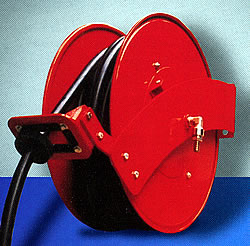
Enclosed electrical cable reel on the ceiling of a workshop, cable running down to a workstation
1
The slip ring firstRings and brushes define the number of conductors, the admissible current and the service life.
2
Count the polesPhases, neutral and earth: a complete three-phase supply needs five poles, not three.
3
Derating when woundThe gap reaches half the current on site reels. Manufacturers give both values.
4
Enclosed, open, motorisedWorkshop, long lengths or on-board applications: three architectures for three constraints.

Our cable range

From the workshop to the overhead crane


Enclosed reels for the fixed station, open drums for large cross-sections, motorised reels for on-board applications, and earthing reels for tanker unloading.

Filter the whole range →

The slip ring, the key component

For current to flow while the drum turns, the cable cannot be hard-wired. A set of rings and brushes provides the electrical connection continuously. It is what defines the number of conductors available, the admissible current and the service life of the reel.

Three characteristics are read together: the number of poles, which must cover phases, neutral and earth; the cross-section of the cable; and the admissible current per pole. A three-pole slip ring is not enough for a three-phase supply with neutral and earth, and that cannot be recovered after installation.

A wound cable heats up

A cable left on its drum dissipates the heat it produces poorly. Its admissible current is therefore markedly lower wound than unwound, and the gap reaches half on site reels. On a station where the cable remains partly wound at all times, it is the “wound” value that must be used for sizing.

Enclosed, open, motorised

The enclosed reel protects the cable and suits workshops and traffic areas. The open reel accepts greater lengths and larger cross-sections, at the price of a visible footprint. The motorised reel is required on on-board applications — aerial platforms, overhead cranes, telescopic booms — where manual pulling is no longer conceivable.

The spring pulls permanently, including at rest. That is the limit the choice between spring and motor must settle, and it is not only a matter of length. A spiral spring keeps the cable under tension whatever the position of the machine; on a large cross-section left unwound for hours, that constant pull fatigues the core. A motorised reel controls its effort and can bring it down to almost nothing once the machine is stationary.

A simple check: ask for two lengths, not one. A spring reel does not accept the same length depending on whether the cable runs out horizontally or descends vertically, since the weight of the unwound part then adds to the effort taken up by the spring. At STEMMANN, a size rated for 60 m in horizontal run-out falls to 27 m in vertical descent — more than half. A supplier who states only one value has not sized the descent case, and that is the one that breaks.

One case escapes this rule and deserves to be known: if the reel rises and descends with the machine and the supply stays at the fixed point, the weight of the cable no longer bears on the sizing of the spring. This arrangement allows lengths far greater than a classic descent, and it is too rarely considered.

The special case of earthing

Earthing reels do not distribute energy: they discharge electrostatic charges during a transfer of flammable liquid, between a tanker or a drum and the earth of the installation. They often include a clamp and, depending on the model, a continuity monitor that permits or prohibits the transfer. It is safety equipment in its own right, dealt with on our ATEX page.

Cable and earthing reels in the catalogue

67 références au catalogue GEDO, réparties sur 11 marques. Chaque fiche porte son tableau de références complet.

CAVOTEC

CONDUCTIX

COXREELS

GEPRO

HANNAY

NEDERMAN

NEWSON GALE

REELCRAFT

STEMMANN

VAHLE

ZECA

Electrical cable reel in a workshop

GEDO, multi-brand distributor

Sizing on actual use, not on the rating plate


Give us the voltage, the current, the length needed and the proportion of cable that stays wound in service. It is this last piece of information, almost never volunteered, that prevents overheating.

The cable length to order is not the length of travel

It is the most frequent costing error on a cable reel. The total length adds four terms: the maximum unwound length, the installation height between the reel and the cable route, two safety turns that remain permanently on the drum, and the free end needed for connection.

The two turns are not a comfort margin. They take up the load at the anchorage of the cable on the winding body, and selection tables already count them in the published capacities. A cable ordered flush with the travel ends up in tension on its anchorage at every end of travel.

The real saving is made at the design stage: feeding the cable at the midpoint of the travel halves the length needed. On a new installation, it is the first question to settle, before comparing reel sizes. The VAHLE tables state it explicitly and distinguish the installation configurations one by one, which few catalogues do.

The stated weight is not that of the reel

A reading detail with direct consequences on a bracket or an overhead support: on spring reels, the published mass is often that of the body without its springs, in minimum pole configuration. At VAHLE, a 530 mm drum is rated 80 kg, but each spring of the largest series adds 21.5 kg. On a two-spring model, the gap exceeds 40 kg — half the displayed value, before the cable itself.

The check fits in one question: ask for the mass in working order, springs and slip ring included, rather than the catalogue base mass. That is what sizes the support.

Frequently asked questions

What cable length should be ordered for a reel?

Not that of the travel. The total length adds the maximum unwound length, the installation height above the cable route, two safety turns that remain permanently on the drum, and the free end for connection. Feeding at the midpoint of the travel halves the length needed.

Why unwind a cable reel completely?

Because a wound cable dissipates its heat poorly. Its admissible current when wound is far below its unwound value, and exceeding it causes overheating and then melting of the sheath.

How many poles are needed?

Count phases, neutral and earth. A single-phase supply needs three poles; a three-phase supply with neutral and earth needs five.

Can a cable reel be used for earthing?

No. One distributes energy, the other discharges electrostatic charges and often includes a continuity monitor. An unloading installation needs the latter.

What cable length does a spring reel accept?

It depends on the run-out direction as much as on the drum size. A spring reel does not accept the same length depending on whether the cable runs out horizontally or descends vertically, the weight of the unwound part then adding to the effort taken up by the spring. A size rated for 60 m in horizontal run-out may fall to 27 m in vertical descent. A supplier who states only one value has not sized the descent case.

Spring or motorised reel?

The spring suits moderate travels and machines without their own power supply. The motor becomes necessary beyond a hundred metres or so, when the permanent pull of the spring fatigues a large-section cable left unwound, or when the reel must follow the movement of the machine. A motorised drive controls its effort and can bring it down to almost nothing once the machine is stationary.