
Two routes to a certified reel
The first is the already certified reference. Several manufacturers in our catalogue offer series covered from the factory, delivered with their marking and their EU declaration of conformity. It is the quickest route when the zone, the fluid and the pressure fall within the declared scope.
The second is dedicated certification. When no existing reference covers the need — typically a large-capacity motorised reel for a specific zone — we have the configuration certified. The unit is then certified for your installation, not approximately adapted to it. This route is a real commitment, in technical file as in lead time: it is decided after qualification of the need, never from a catalogue.
What our catalogue actually covers in hazardous areas
Four manufacturers in our catalogue carry an ATEX offer, and their logics do not overlap.
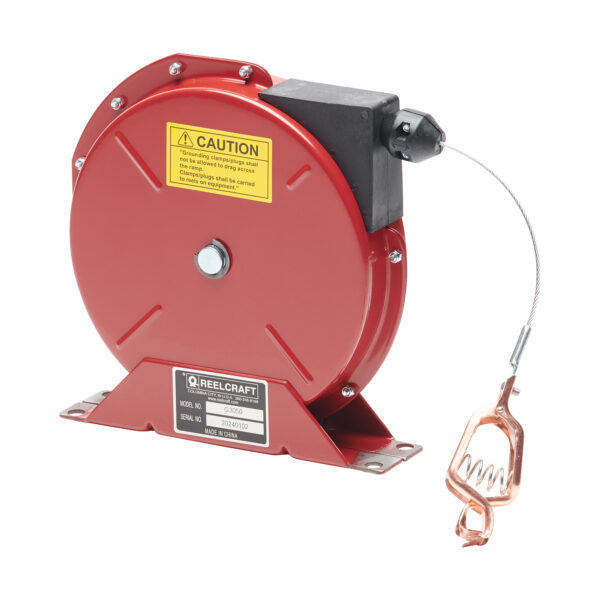
Reelcraft offers most of its hose reel range in an ATX version, small and large frames alike: the -ATX suffix added to the reference designates the version intended for explosive atmospheres. The scope covers the spring-rewind series 3000 to 5005, 7000 and HD70000, 80000 and D80000, the dual-support DLC and DP7000 series, the very-large-capacity 9000 series, the F and FD fuel series, the PW, CT and CM pressure-washing series, the TW and BA welding series, the hand-crank reels of the H, CU, CT and BC series, the 30000 series, and the large-frame Nordic range — series 2400, 3700, 3900, 5900 and 6000, up to 305 metres of hose and 102 mm inside diameter. The technical file of the ATX range is lodged with Bureau Veritas, notified body 2004, under number EPS 23 ATEX 3 048, valid until 29 January 2033. To these are added the earthing reels of the G series, marked II 2G Ex h IIB T4 Gb and II 2D Ex h IIIC T100 °C Db.
TEHA covers group IIC, including hydrogen and acetylene, with two series: the automatic ST Ex and the manual stainless steel STKi2 Ex, in Ex h IIC T6…T4 Gb and Ex h IIIC T6…T4 Db, for zones 1, 2, 21 and 22.
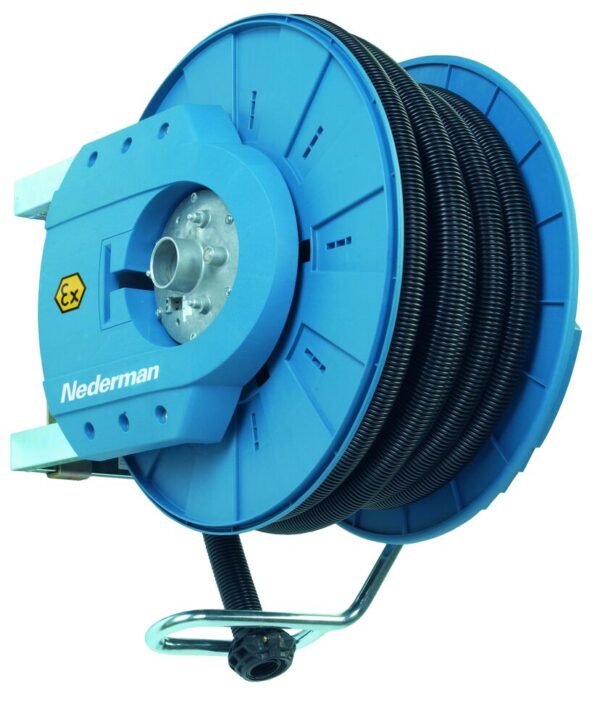
Sauro Rossi brings the spring reels of the AUTO series, whose suitability for explosive atmospheres is stated in the manufacturer’s catalogue. Nederman completes the offer with the 881 Ex series. On motorised reels, whatever the brand, the ATEX version is handled case by case.
This breadth has a practical consequence. In the vast majority of enquiries, the question is not whether an ATEX reel exists for the need, but which of the available configurations matches the zone, the fluid and the pressure. The references concerned can be filtered in our finder.
Why motorised reels escape this rule
One family is an exception, and it is better to know it before launching a consultation: large motorised cable reels, those that feed a gantry crane, a bucket-wheel excavator or a quarry machine. They are rarely certified, for two reasons that add up.
The first relates to their nature. The hose reels described above are non-electrical equipment: they fall under the Ex h protection mode and the route of the lodged technical file. A motorised reel, on the other hand, has a motor, a brake and above all a slip ring with brushes — a sliding contact, hence a source of ignition by construction. It falls into the category of electrical equipment, for which category 2 requires EU type examination by a notified body.
The second relates to how they are made. A type examination covers a model representative of a production run. Yet these reels are designed machine by machine — travel, cable cross-section, drum diameter, drive technology. There is no representative model on which to base the examination, and the assessment would have to be repeated for each unit.
The solution adopted in operation is almost never to certify the reel. It consists of installing it outside the classified zone and letting only the cable enter the zone. It is a layout choice, not an equipment choice, and it is decided when the machine is positioned — not once the civil works are poured.
When that solution is impossible, two routes remain: a series-certified version from the manufacturer, when one exists in its catalogue, or a specific overall assessment conducted with a notified body. Both are decided before the order.
The check is simple and applies to any offer: ask for the certificate or file number and the name of the notified body. A mention “ATEX compliant”, “suitable for zone 2” or “explosion-proof” without a number or a body commits no one and is not a certification.
Reading an Ex marking: the example of a certified series
A certified reel carries a standardised marking that says exactly what it covers. That of the TEHA ST/Ex series, which we distribute, reads as follows:
II 2 G Ex h IIC T6…T4 Gb X · II 2 D Ex h IIIC T6…T4 Db X
| Element | What it means |
|---|---|
| II | Equipment group: surface industries, excluding mines |
| 2 G and 2 D | Category 2, for gases as for dusts — hence zones 1 and 2, 21 and 22 |
| Ex h | Protection mode for non-electrical equipment, according to EN ISO 80079-36 and 80079-37 |
| IIC and IIIC | The most demanding explosion groups: IIC covers up to hydrogen and acetylene, IIIC conductive dusts |
| T6…T4 | Temperature class, from 85 to 135 °C of admissible surface temperature depending on the conditions of use |
| Gb and Db | Equipment protection level, corresponding to category 2 |
| X | Special conditions of use, detailed in the instructions — the most often neglected point |
The declared scope of this series covers water, oil, air and grease, from 0 to 300 bar, from 0 to 100 °C, in nominal diameters from 8 to 19 mm. Conformity rests on EN ISO 80079-36 and EN ISO 80079-37, with the technical file lodged with the notified body IBExU.
That is the route provided by Directive 2014/34/EU for non-electrical category 2 equipment, not the EU type examination applicable to electrical equipment. This distinction explains a frequent confusion: one sometimes hears that a reel cannot be ATEX-certified, which amounts to applying to it a procedure that does not concern it.
IIB or IIC: what the explosion group changes
The explosion group indicates which gases the unit covers, and it is the parameter that most often rules out a reference under study. Group IIB covers the vast majority of industrial gases and vapours: hydrocarbons, solvents, alcohols. Group IIC adds hydrogen and acetylene, whose minimum ignition energy is markedly lower. A IIC unit is suitable wherever a IIB unit is; the reverse is not true.
In practice, an installation handling hydrogen or acetylene accepts only a unit declared IIC, which is the case of the TEHA ST/Ex series described above. For fuel unloading, a solvent area or a paint shop, a IIB unit covers the need: that is the case of the Reelcraft G3000 series earthing reels in ATX version, marked II 2G Ex h IIB T4 Gb and II 2D Ex h IIIC T100 °C Db, whose technical file is lodged with Bureau Veritas, notified body 2004, under number EPS 23 ATEX 3 048.
The special conditions, that famous “X”
Three obligations condition the validity of the marking on this series, and they fall on the installer as much as on the manufacturer.
Equipotential bonding must be carried out at installation, with a conductor of at least 4 mm² connected to one of the reel’s fixing screws. The hose must be electrically conductive, with a resistance below 10⁶ ohms — a standard hose fitted to a certified reel cancels the benefit of the certification. And the temperature, ambient as well as that of the fluid conveyed, must not exceed 100 °C, failing which the temperature class changes and the declared scope with it.
The instructions further require a check of the electrical continuity of the hose and the equipotential bonding every three months, and a check of the tightness of the fixings every six months. An ATEX reel correctly chosen but never checked ceases to be compliant.
Zone and category: what determines the scope
Zones are read in two families. For gases, vapours and mists, zone 0 designates a permanent or frequent presence of explosive atmosphere, zone 1 an occasional presence in normal operation, zone 2 a rare and brief presence. For combustible dusts, zones 20, 21 and 22 follow exactly the same gradation.
To each zone corresponds an equipment category: category 1 for zones 0 and 20, category 2 for zones 1 and 21, category 3 for zones 2 and 22. A category 2 unit therefore also covers the less demanding zone that follows it; the reverse is never true.
An often overlooked point: the directive also covers non-electrical equipment. A manual reel falls within its scope, because it has moving parts, a swivel joint and a metal mass liable to accumulate static electricity.
The four points that decide
Electrical continuity first: drum, shaft, bracket and hose must form a conductive assembly connected to earth, without any break. It is the first cause of non-conformity noted in installation audits.
Then the materials in contact, because an impact between certain pairs of metals can produce a spark — stainless steel constructions and suitable coatings answer this constraint better than painted steel.
The swivel joint, whose sealing and seals determine the absence of fluid leakage, and therefore the absence of feed to the explosive atmosphere.
The hose finally, which must be conductive and connected so as to ensure continuity. A certified reel fitted with the wrong hose loses the benefit of its certification.